
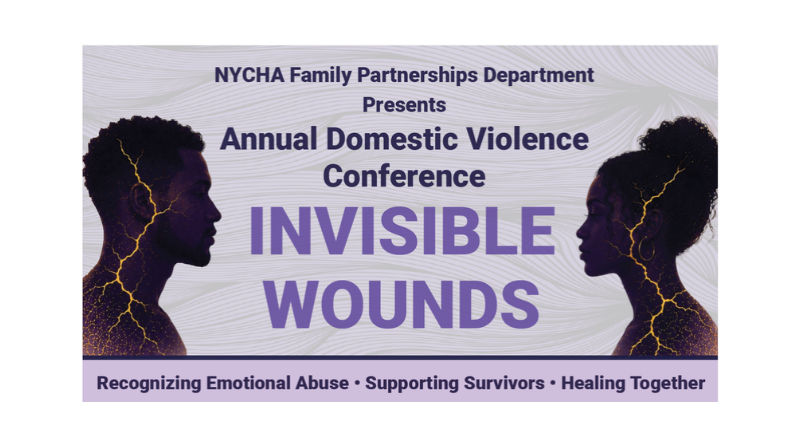
NYCHA Hosts Virtual Domestic Violence Awareness Conference Focused on Emotional Abuse
On October 28, NYCHA’s Family Partnerships Department hosted its annual virtual Domestic Violence Awareness Conference in recognition of Domestic Violence Awareness Month, bringing together residents, staff, advocates, researchers, and service providers to discuss the often-overlooked effects of emotional abuse. This year’s conference theme, “Invisible Wounds: When Words Hurt – The Harm of Emotional Abuse,” explored how emotional abuse affects individuals and families, how to recognize warning signs, and where survivors can turn to for support.
Nicole White, Queens and Staten Island Borough Administrator in Family Partnerships, organized the conference and opened the conference by explaining its theme.
“When we hear the words domestic violence, we often think about physical abuse,” Ms. White said. “But what about the hurt we can’t see? The constant criticism. The hurtful words. The manipulation. The fear of saying or doing the wrong thing. These are things that can deeply affect a person’s confidence, peace, and sense of self-worth. And that’s why today’s conversation is so important. Because words have power.”
NYCHA Chief Operating Officer (COO) Eva Trimble delivered opening remarks, emphasizing the importance of open conversations in helping to eliminate stigma and help others.
“All too often some of these conversations don’t get enough airtime, so I want to start by thanking the survivors that are going to be speaking today for sharing your stories,” COO Trimble said. “I know that’s not an easy thing to do, but every time you do, you help someone that you don’t even realize you’re helping.”
The conference featured a presentation on understanding emotional abuse and its impact by Sahnah Lim, PHD, MPH, Associate Professor in the Department of Population Health at NYU Grossman School of Medicine. Dr. Lim explored two forms of emotional abuse: expressive abuse, which can involve name calling, criticism, humiliation, and explosive anger; and coercive abuse, which involves ongoing efforts to monitor, isolate, manipulate, and restrict a partner’s freedom.
Dr. Lim also discussed the prevalence of emotional abuse, the communities who are at higher risk of experiencing it — women, sexual minorities, and racial/ethnic minority groups — and its effects on survivors’ health, including depression, anxiety, post-traumatic stress disorder, chronic pain and disease, and substance abuse. She also shared that Hawaii is the only U.S. state to have criminalized coercive control as a standalone crime.
Following the research presentation was a survivor conversation moderated by Fatima Lundy, Program Manager in NYCHA’s Management Services Department. Panelists Nicole Delancey, Director of Administration and Operations at Sanctuary for Families, and Victoria Morgan, founder of One Strong Mother, shared their personal experiences with domestic violence and emotional abuse and their journeys toward healing and advocacy.
“I was once a client of Sanctuary for Families, one of the largest DV and gender-based violence organizations on the East Coast, established in 1983,” Ms. Delancey said. “We all probably can relate to having different types of abuse in our lives, from verbal to mental and emotional abuse, financial, and even physical, and I was one of those who went through pretty much every one of those. I took the necessary steps to remove myself from that situation and get to a better place through the support of friends, families, and places such as Sanctuary for Families. I was able to come out of that situation, get involved with the cause, and now I am an advocate for survivors and doing my part in helping others get from where I was to where I am now.”
Ms. Morgan shared about her domestic violence experience in her long-term marriage, followed by emotional abuse with a partner after her marriage. Her experience gave a face to the emotional abuse definition in Dr. Lim’s earlier presentation: Ms. Morgan experienced the coercive control of being isolated from her family and friends, being gaslit and manipulated, and having her finances controlled.
“Every single day I still showed up as a leader at work, as a mother, as a friend to my friends as if none of it were happening behind the scenes,” Ms. Morgan said. “Nobody knew it, nobody saw it, and that’s what emotional abuse does; there are no wounds, no bruises, no beatings, but it hurts and wears you down to the core.”
For Ms. Morgan, one of the conversations that helped her find the strength to leave was when her daughter asked her, “‘Mom, do you want me to bring home someone like him?’”
The program also featured a guided reflection led by Ms. Lundy with the panelists, where attendees were asked to “Imagine your concern is resolved overnight. When you wake up tomorrow, what is the first sign that tells you a meaningful change has happened?”
Following the exercise, representatives from organizations and NYCHA departments also shared information about resources available to survivors. Lu Davinci, Services Manager at the National Domestic Violence Hotline, discussed the organization’s free, confidential support services, which include assistance in more than 270 languages. Kimberlina Kavern, Senior Director of Safe Horizon’s Crime Victim Assistance Program, highlighted the organization’s work supporting crime victims and its network of advocates stationed in all 86 NYPD precincts. Irlanda Fernandez, Program Manager in NYCHA’s Applications & Tenancy Administration Department, provided information about NYCHA’s emergency transfer process for residents experiencing domestic violence.
Resources for Support
National Domestic Violence Hotline: Call 800-799-SAFE (7233), text START to 88788, or visit www.thehotline.org. Free, confidential support is available 24/7, with professional interpretation services in more than 270 languages.
Safe Horizon: Provides support and services to survivors of domestic violence and other crimes. Visit www.safehorizon.org.
Sanctuary for Families: Provides comprehensive services to survivors of domestic violence and gender-based violence. Visit https://sanctuaryforfamilies.org.