
NYCHA Prepares for Extreme Cold and Winter Storm
NYCHA announced that it will activate its virtual Emergency Operations Center (EOC) from 8 a.m. to 10 p.m. on Sunday, January 25, to centralize efforts and respond to an arctic airmass currently forecasted to bring extreme low temperatures and expected snowfall of 13 inches citywide on Sunday.
Citywide, temperatures on Sunday are expected to drop as low as 15 degrees, compounded by wind gusts of up to 28 miles per hour that will result in wind chill values as low as 4 degrees. Temperatures are expected to remain low through the rest of the week with high temperatures rising into the low 20s by Wednesday.
NYCHA encourages residents to immediately submit work order requests for concerns or problems with heat and/or hot water so staff can quickly identify developments that may be experiencing heat issues, by using MyNYCHA or calling the Customer Contact Center at 718-707-7771.
NYCHA’s Emergency Management and Services Department manages the virtual Emergency Operations Center – which will provide support to heating response teams in addition to NYCHA’s 24/7 Heat Desk – and coordinates efforts among the operations, heating, technical services, resident engagement, intergovernmental affairs, and communications departments to minimize the extent of unplanned heat and/or hot water outages. The EOC also enables NYCHA staff to track, monitor, and report all heat complaints and outages.
The EOC also coordinates with New York City Emergency Management (NYCEM) and other City agencies to provide safety and preparedness information to public housing residents and employees.
NYCHA’s full-time staff and third-party vendors monitor heating infrastructure at every development, and staff will be on call to address any heat-related service interruptions.
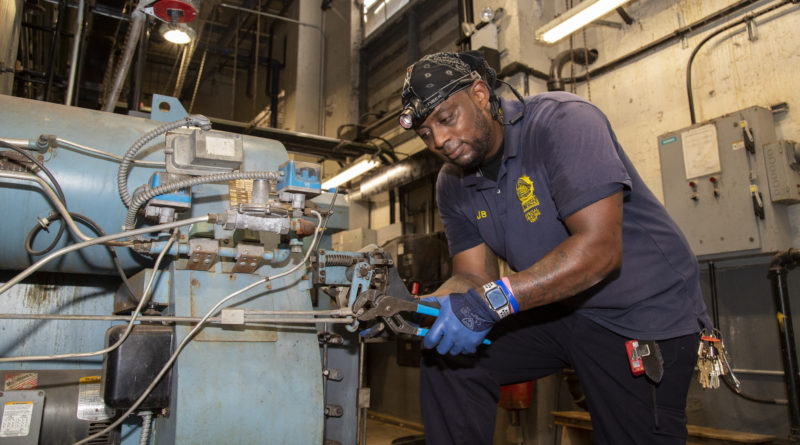
NYCHA’s nearly 700 full-time heating staff include heating plant technicians, maintenance workers, plumbers, plumbers’ helpers, oil burner specialists, electricians and electrician’s helpers, and their supervisors; they maintain systems that span boiler plants, heat distribution pipes, and apartment radiators.
The Authority has 34 skilled trades teams that include 29 plumbing and five electrical teams, as well as seven oil burner mechanics and 20 roving teams consisting of front-line heating staff. NYCHA has also procured labor and material contracts to support emergency response and restoration to services where needed. In addition, the 24/7 Heat Desk tracks, responds to, and minimizes potential service disruptions.
NYCHA has a reserve of staged and non-staged mobile boilers that can be activated in the event of a heating outage. There are currently 13 mobile boilers connected to developments and nine mobile boilers that can be accessed if needed.
NYCHA has over 3,800 pieces of heating equipment, including boilers, hot water systems, and distribution heating assets, at over 1,800 residential buildings across the city. The average age of NYCHA’s boilers is 28 years old – over the 20-25-year average expected useful life – making the Authority’s work of boiler overhauls, preventative inspections, and monitoring and rapid response critical to heating season operations.
Each year, beginning October 1, all New York City building owners must maintain an indoor temperature of at least 68 degrees between 6 a.m. and 10 p.m. when it’s below 55 degrees outside. From 10 p.m. to 6 a.m., the indoor temperature must be at least 62 degrees regardless of the temperature outside. Hot water must be kept at a minimum temperature of 120 degrees at the source year-round.
Residents should contact NYCHA when:
- The temperature is out of range: The temperature in their apartment should never fall below 68 degrees during the day or 62 degrees at night.
- They have hot pipes and cold radiators: If the riser pipes are hot and the radiator is cold, residents should first make sure the hand valve is open (to the left). If the valve is open and the radiator is still cold, residents should tell NYCHA staff and ask them to change the radiator trap.
- The window is not closing properly: Residents should request window repair if the window is not closing all the way or if air is coming in above, below, or between the sashes.
- Steam is leaking into the apartment: Residents should ask NYCHA staff to fix all steam leaks immediately.
- The building’s front entrance door does not fully close.
Some best practices for helping to keep apartments warm during the winter months include:
- Keeping windows fully closed, top to bottom, because open or leaky windows can make you feel cold even if the heating system is working as it should. If they feel air, residents should contact NYCHA.
- Consider removing the window air conditioner, or covering it, for the winter. Leaving an air conditioner installed in the window is the same as having a six-inch hole in your wall. If residents cannot remove and store their air conditioner for the winter, they should consider insulating it with a cover and weather-stripping around the sides to reduce cold air coming in.
- Moving furniture away from radiators or baseboards to keep the air moving freely. If radiators/baseboards are blocked by furniture, they will only heat what is in front of them and not the rest of the room.
- Opening the hand valve on the radiator. Turn the knob to the left to open it (more heat) and the right to close it (less heat).
- Lowering blinds or drawing curtains at night. Warm air hitting a cold window will cause a draft, even if there’s no cold air coming in from the outside. The curtains or blinds prevent drafts.
- Keeping hallway and stairwell windows closed. Many are left open year-round, letting in cold air all winter.
For more information and resources, visit nyc.gov/extreme-cold-weather.